
I think I’ve mentioned several times in this blog that I got into basketball through the NBA and don’t (yet) know anything about college basketball. To broaden my horizons, I bought a book that focuses on college basketball and not the pro level. I came across Don’t Put Me In, Coach by Mark Titus rather by chance. Even though it is and was popular among fans in the US, I had never heard of this book or Mark Titus until recently.
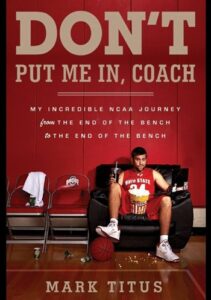
At the beginning of Don’t Put Me In, Coach, Titus describes how he became perhaps the most famous benchwarmer in the NCAA. He had a growth spurt at an early age and was taller and stronger than his teammates, which allowed him to dominate basketball in the lower age groups. He was also successful in high school. According to Wikipedia, he is one of only five players in Brownsburg High School history to score more than 1,000 points during his time there. Another is none other than Gordon Hayward (I just wanted to mention the name to justify why this book is appearing on a blog called NBA Books).
Mark Titus’ life changed on one fateful day when his AAU team played against another team. Playing for the opposing team were future NBA players Greg Oden, Mike Conley (still in the NBA at the time of this writing), Eric Gordon, and Daequan Cook, among others. Titus played an outstanding game and exposed the only weakness of the favored opponent (defending three-point attempts). Opposing coach Mike Conley Sr. then recruited Titus for his AAU team, and the rest is history, as they say.
From short-time team manager to Walk-on player
In the meantime, Titus himself had not had another growth spurt and was no longer dominant in basketball, but he was still a good player. His teammates and friends Oden, Conley, and Cook went to play basketball at Ohio State University, where they prepared for their future professional careers. Titus also enrolled at Ohio State (more by coincidence), but his basketball career seemed to be over.
At first, he wanted to become the manager of the Ohio State basketball team, but he gave that up after a short time. Due to a number of injuries (including Oden, who unfortunately was plagued by injuries for the rest of his career), the team barely had enough players for proper training and scrimmages. Coach Thad Matta and an assistant then asked Titus if he wanted to train with the team and offered him the chance to become a walk-on member of the team.
In case you know as little about college basketball as I do (which probably doesn’t apply to anyone), according to Wikipedia, a walk-on is…
[…] someone who becomes part of a college team without being recruited or awarded an athletic scholarship. Walk-on players are generally viewed as less significant compared to the scholarship players, and may not even be placed on an official depth chart or traveling team. However, a walk-on player occasionally becomes a noted member of the team.
Mark Titus started his career as a walk-on, someone who was put in in the last minute of the game when the outcome had long since been decided, and he ended his career as… exactly the same. Hence the subtitle of the book: My incredible NCAA journey from the end of the bench to the end of the bench. In his four years at Ohio State, he scored exactly 9 points and played a total of 48 minutes. Nevertheless, he became one of the best-known and most popular players on his team.
This fame began with a blog that Titus started. The name of the blog was “Team Trillion.” For those who, like me, were unfamiliar with the term, a trillion is a box score for a player that reads from left to right as a 1 and twelve zeros. The 1 is minutes played and the zeros are all other stats in the box score (points, rebounds, assists, shots, etc.). Titus himself further defines a perfect trillion as a player who also has a plus/minus of 0 and therefore had no positive or negative impact on the outcome.
Don’t put me in, Coach is a funny book
On his blog, he recounted his experiences as a walk-on and benchwarmer, his pranks and jokes on Evan Turner, who joined Ohio State in Titus’ second season (and was later selected second overall by the Philadelphia 76ers in the 2010 NBA Draft), and the latest trillions he or other benchwarmers “achieved.”
Thanks to the blog and his playful and self-deprecating nature, Titus even made it as a guest on Bill Simmons’ podcast (back then ESPN). He also registered for the 2009 NBA Draft for fun and was asked by the NBA to withdraw his name. Titus had planned to withdraw his name in time for the draft anyway so that he could retain his eligibility for Ohio State. However, this stunt generated even more public attention and popularity.
Otherwise, in Don’t Put Me In, Coach, Titus talks a lot about the inner workings of his team. In their first year (with Oden and Conley on the team), the Buckeyes reached the national championship game. However, they lost to Florida (with Al Horford and Joakim Noah). For me, this glimpse into the inner workings of a college team was very interesting, as I don’t know much about college basketball, as I mentioned earlier.
The book is written with a lot of humor and self-irony. Some jokes are a bit repetitive, but I found it funny in many places. For example, in Titus’ last year at Ohio State, when he injured his shoulder, he asked Coach Matta to reduce his playing time (he didn’t play more than 20 minutes in any of his four seasons – per season, not per game). Thad Matta, who according to Wikipedia no longer coaches Ohio State but Butler (did I already mention that I don’t know much about college basketball?), is also one of the heroes of the book. He shares the humor of one of his most famous protégés and seems to be a coach that players enjoy playing for.
Get at Amazon