
Jon Finkel’s book Hoops Heist, published in 2020, tells the story of the Seattle SuperSonics and the city of Seattle’s basketball scene and players. I found it interesting because I was a Sonics fan when I first started watching the NBA in the 1990s. Gary Payton, Shawn Kemp, and my fellow German Detlef Schrempf were part of one of the most iconic teams of the ’90s. Plus, as of May 2026, it looks like the Sonics will actually be making a comeback in the not-too-distant future. So this book came out at just the right time.
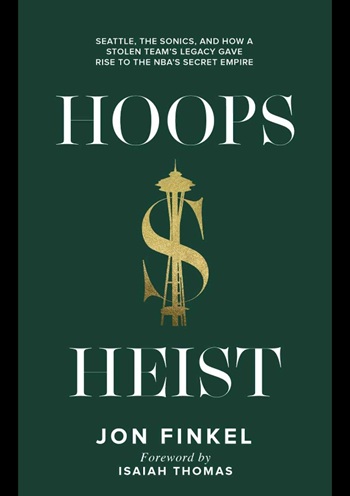
Hoops Heist is divided into two parts. The first part covers the history of the Sonics from their founding through to the shady relocation, during which the residents of Seattle and Sonics fans around the world had their team stolen from them (quite rightly referred to as a heist in the book’s title). The second part explores the basketball culture in Seattle, how the Sonics were closely tied to it, and which players rose to prominence there.
The book includes some amusing anecdotes from the franchise’s early days. For example, there was a special attraction at an away game against the San Francisco Warriors. The Warriors wanted to sell more tickets by having local celebrities play mini-golf in the arena before the game. However, dismantling the mini-golf courses took so much time that the game started with a significant delay, and the players were unable to warm up until late. This is almost reminiscent of the ABA, where Terry Pluto recounted similar stories in his book Loose Balls.
History of the Seattle SuperSonics
In addition, during the Sonics’ first season, some of the home games were not held in Seattle but in the surrounding area to attract fans from across the region. One of these “home games” “in the surrounding area” took place in Phoenix, Arizona—almost 1,500 miles from Seattle.
The Sonics became one of the best teams in the NBA after Lenny Wilkens took over as head coach during the 1977-78 season. The team started 5-17 under head coach Bob Hopkins before Wilkens took over. Lenny not only led the team to the playoffs but even to the NBA Finals, which no one could have anticipated.
The turnaround during the season came so unexpectedly that the Sonics were unable to play Game 4 of the NBA Finals in their home arena, the Seattle Center Coliseum. The city had already leased the arena for another event. The Sonics had to move to the Kingdome, where the Seahawks and Mariners played at the time. Just imagine that happening today. A team unexpectedly makes it to the NBA Finals and can’t play in its own arena because an exhibition is taking place there.
A year later, the Sonics actually won the NBA title. The years that followed were relatively uneventful and are only briefly touched upon in Hoops Heist. The franchise’s next turning point came when Shawn Kemp and Gary Payton were drafted in 1989 and 1990, respectively, and went on to shape the coming decade alongside new coach George Karl. After the high point of that era—reaching the 1996 NBA Finals against the Chicago Bulls—things quickly went downhill again due to contract disputes.
A great description of Seattle’s basketball culture
Last but not least, Jon Finkel describes the (tentative) painful end of the Sonics in Seattle. It’s clear that the author himself found the whole situation shady, which I can totally understand. For example, he describes the press conference held by former owner Howard Schultz and new owner Clay Bennett, which was so poorly acted that it deserved a Golden Raspberry Award. Both tried to assure everyone that they would do everything in their power to keep the Sonics in Seattle. By that point, all Sonics fans already knew that the move to Bennett’s hometown of Oklahoma City was a done deal.
As mentioned, the second half of the book focuses on Seattle’s basketball culture and how it was—and still is—so deeply intertwined with the Sonics. Many players from the city recount how they came into contact with Sonics players as children or teenagers and were allowed to play against them. Gary Payton and Coach George Karl organized summer training camps for the city’s youth, and other Sonics pros also regularly participated in pickup games.
Among the players who grew up in Seattle’s basketball culture and were profiled in Hoops Heist are Jamal Crawford, Doug Christie, Brandon Roy, Nate Robinson, Jason Terry, and Isaiah Thomas. Finkel does an excellent job of describing how closely connected all these players are and how they have consistently supported one another. There’s a story about Jason Terry that Sonics legend Slick Watts—who sadly passed away in March 2025—was his physical education teacher for a while. That’s why Terry played with a headband. Slick Watts had made it famous.
With Hoops Heist, Jon Finkel has written a very interesting book that does a great job of describing the Seattle SuperSonics, basketball in Seattle, and the city’s love for its team. After reading it, it becomes clear why the people of Seattle deserve to have their team back and what that would mean for the entire city.
Get at Amazon