
Jonathan Abrams’ book Boys Among Men is about a generation of players who went straight from high school to the NBA, without any stops in between. If the author sounds familiar to some The Wire fans, it’s because he also wrote the great book All The Pieces Matter about the popular TV series.
Younger readers may never have seen a player to jump straight from high school to the NBA. That’s because it’s not allowed anymore since 2006. Since then, a player must have graduated from high school at least one year prior to entering the NBA Draft. That doesn’t necessarily mean the player has to go to college. He could also play abroad or in the G League for example. The last player to be drafted into the NBA straight out of high school was Amir Johnson, who was selected 56th overall by the Detroit Pistons in 2005 (pretty good 56th pick to be honest).
The first two players to go straight from high school to the NBA were Darryl Dawkins and Bill Willoughby in 1975. Moses Malone also turned pro right after high school, but he signed with the ABA before the NBA/ABA merger. After Dawkins and Willoughby, it would be 20 years before another player dared to make the jump directly to the NBA. That player was none other than Kevin Garnett, who was selected fifth overall by the Timberwolves in 1995.
Kobe Bryant and LeBron James belong to the prep-to-pro generation
Garnett set off something of an avalanche. Over the next ten years, several players took that big step. In 1996, it was Kobe Bryant and Jermaine O’Neal. In 2001, three of the top four picks—Kwame Brown (#1), Tyson Chandler (#2), and Eddy Curry (#4)—came straight out of high school. Following Kwame Brown, a certain LeBron James and Dwight Howard were also selected first overall.
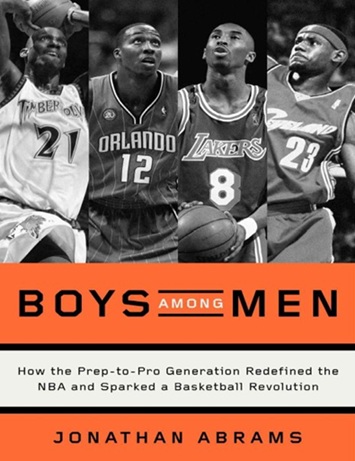
In Boys Among Men, Jonathan Abrams describes the careers of many of these prep-to-pro players and interviewed some of the players themselves, as well as agents and coaches. The book’s cover features photos of the aforementioned LeBron James, Kobe Bryant, Kevin Garnett, and Dwight Howard. What they all have in common is that they became NBA stars and MVPs (or at least MVP candidates). Therefore, one might think that the chapter on prep-to-pro players was a complete success story.
But there were other examples as well. Players who were stars in high school and considered brilliant talents, but for whom the jump to the NBA simply came too soon. They weren’t yet physically and/or mentally ready for that step, and a few years in college could have made a big difference. Examples include Korleone Young (who actually got his name from The Godfather) and Leon Smith, who even survived a suicide attempt during his rookie season. Abrams recounts these players’ stories just as he does those of the stars.
Boys Among Men examines the topic from all angles
Stories like these also led to the current ban on going straight from high school to the NBA. The book features the views of both supporters and opponents of this rule. Among them was the late David Stern, who was the NBA commissioner at the time. Others felt that you couldn’t dictate to players when they should or shouldn’t make the jump to the NBA. After all, in sports such as tennis there are some players who turn pro at the age of 15 or 16.
So there is no clear answer to the question of whether the prep-to-pro era was a success or not. However, Jonathan Abrams doesn’t just give a voice to players and agents, but also to people who were affected by the rules of that time in other ways. One example is Rick Stansbury, who was first an assistant coach and then head coach at Mississippi State at the time. Stansbury reportedly had verbal commitments from Jonathan Bender, Travis Outlaw, and Monta Ellis. All three, however, ultimately decided to go straight from high school to the NBA. The story of Stansbury and Mississippi State could have been different if these players had played in college for even just one year.
One consequence of the new rule is today’s “one-and-done” era, in which players, because of the rule, go to college with the clear goal of staying there for only one year before entering the NBA draft. This issue is also explored in Boys Among Men. Once again, both critics and supporters of this practice have their say (for example, John Calipari, who has had success at the University of Kentucky with some of these one-and-done players).
I really enjoyed Boys Among Men, and the book wasn’t boring for a single second. You can even learn something here about superstars like LeBron James or Kobe Bryant. But what I liked best was that Jonathan Abrams also told the stories of those who were once considered potential stars but were forgotten by history. Just like in the book about The Wire mentioned in the introduction, the author has once again succeeded in writing a very compelling book.
Get at Amazon